What Your Legacy Systems Are Really Costing You — And Why Modernization Is the Smarter Investment
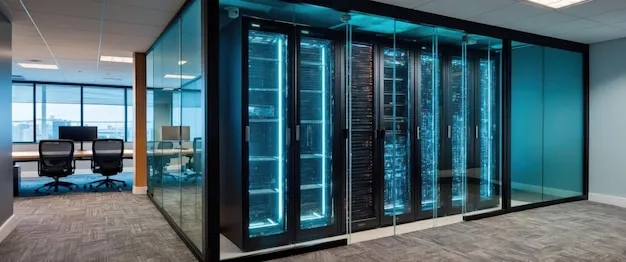
Photo: enterprise server room legacy technology modernization business meeting, via img.freepik.com
The Illusion of Stability in Aging Infrastructure
There is a familiar logic that governs technology budgets in mid-market enterprises across the United States: if the system is running, leave it alone. Legacy platforms that have been operational for a decade or more carry an aura of reliability that is difficult to argue against in a boardroom. They are paid for, understood by at least a handful of senior staff, and — on most days — functional.
What this reasoning consistently fails to account for is the compound cost of that stability. Integration overhead, manual workarounds, security exposure, and the perpetual drain on developer time to maintain systems built on obsolete frameworks do not appear as a single line in the annual budget. They are distributed across departments, absorbed into project timelines, and rationalized as simply the way things work. The result is a hidden tax on operational efficiency that grows more punishing with each passing year.
Mapping the True Financial Footprint
To understand the real cost of legacy system integration, it is necessary to look beyond the IT department's maintenance contracts. Research from Gartner and IDC has consistently found that organizations running heterogeneous legacy environments spend between 60 and 80 percent of their IT budgets on maintenance activities rather than innovation. For a mid-market company with an annual IT spend of $5 million, that translates to as much as $4 million per year simply keeping the lights on.
Consider a regional insurance carrier based in the Midwest that ProelioSoft worked with in a consulting capacity. The organization had been operating a policy management platform originally deployed in the early 2000s alongside a newer CRM system acquired through a 2018 acquisition. Bridging these two environments required a custom middleware layer that demanded roughly 1,400 developer hours annually to maintain. When fully loaded with salary, benefits, and opportunity cost, that single integration point was consuming approximately $210,000 per year — a figure that had never been formally quantified before the engagement began.
That number does not include the cost of the three to four hours per week that the operations team spent manually reconciling data discrepancies between the two systems, nor does it account for the compliance risk introduced by inconsistent customer records that occasionally triggered state regulatory inquiries.
The Cascading Operational Impact
Financial costs alone tell only part of the story. Legacy integration creates operational friction that compounds across an organization in ways that are difficult to measure but impossible to ignore.
Time-to-market is perhaps the most consequential casualty. When development teams must account for the idiosyncrasies of a legacy system every time a new feature is built — mapping data structures, writing translation layers, testing against undocumented edge cases — release cycles stretch from weeks to months. In competitive markets, that delay is not merely inconvenient; it is a structural disadvantage.
Talent retention presents a related challenge. Experienced engineers who joined the workforce after 2010 have limited patience for environments dominated by COBOL, outdated Oracle configurations, or monolithic architectures that resist modern DevOps practices. Organizations clinging to legacy infrastructure routinely report difficulty attracting mid-career developers, and the cost of that talent gap — in recruiting, onboarding, and institutional knowledge loss — rarely surfaces in legacy system cost analyses.
Building the ROI Case for Modernization
For technology leaders tasked with justifying modernization investments to a CFO or board of directors, the challenge is translating operational pain into financial language. The following framework has proven effective in enterprise contexts:
Step 1: Quantify current-state costs comprehensively. This means capturing not just vendor maintenance fees and licensing, but developer time allocated to integration maintenance, manual reconciliation labor, incident response costs, and any regulatory or compliance penalties attributable to data inconsistencies.
Step 2: Model the cost trajectory. Legacy system costs do not remain static. As original developers retire and vendor support contracts expire, maintenance costs accelerate. A five-year projection that accounts for this trajectory typically makes a compelling case on its own.
Step 3: Define the modernization investment with precision. Vague modernization proposals invite skepticism. A well-structured business case specifies whether the approach is a phased re-platforming, a strangler-fig migration, or a full replacement, and ties each phase to measurable cost reductions or revenue enablement.
Step 4: Apply a risk-adjusted ROI calculation. Modernization carries execution risk, and leadership will want to see that acknowledged. Presenting a base-case, best-case, and downside scenario demonstrates analytical rigor and builds credibility with financially-oriented executives.
A manufacturing firm in the Southeast applied this framework ahead of a platform consolidation project. Their analysis identified $1.8 million in annual legacy-related costs across integration maintenance, manual processes, and lost productivity. The modernization program carried a total investment of $2.4 million over 18 months. At steady state, the organization projected $1.4 million in annual savings — a payback period of under two years and a five-year NPV that made the decision straightforward.
Why Phased Modernization Outperforms Big-Bang Replacement
One of the most persistent misconceptions about enterprise modernization is that it requires a wholesale system replacement — a high-risk, high-disruption event that justifies continued inaction. In practice, the most successful modernization programs adopt an incremental approach that delivers measurable value at each stage while managing organizational and technical risk.
The strangler-fig pattern, in which new capabilities are built on modern architecture while legacy functionality is progressively retired, has emerged as the preferred methodology for organizations that cannot afford extended operational disruption. This approach allows development teams to demonstrate ROI early in the program, maintain business continuity throughout, and build organizational confidence in the modernization effort before tackling the most complex legacy components.
For US enterprises operating under regulatory frameworks such as HIPAA, SOX, or state-level data privacy statutes, this incremental approach also provides the opportunity to address compliance requirements systematically rather than attempting to satisfy them all within a compressed replacement timeline.
Repositioning Modernization as a Strategic Investment
The organizations that consistently extract the greatest value from technology modernization are those that reframe the conversation at the executive level. Legacy system integration is not a technology problem to be managed — it is a business performance constraint to be eliminated.
When a CTO presents modernization as an initiative that will reduce operational costs, accelerate product development, mitigate compliance risk, and improve the organization's ability to attract technical talent, the budget conversation changes fundamentally. The question shifts from whether the organization can afford to modernize to whether it can afford to continue deferring the investment.
At ProelioSoft, our approach to enterprise modernization is grounded in exactly this perspective. We work with technology and business leadership together to build the analytical foundation that turns modernization from a technical aspiration into a defensible, financially compelling strategic priority. The organizations that treat this work seriously are the ones that emerge from the process with both cleaner architecture and stronger competitive positioning — and the numbers, consistently, bear that out.